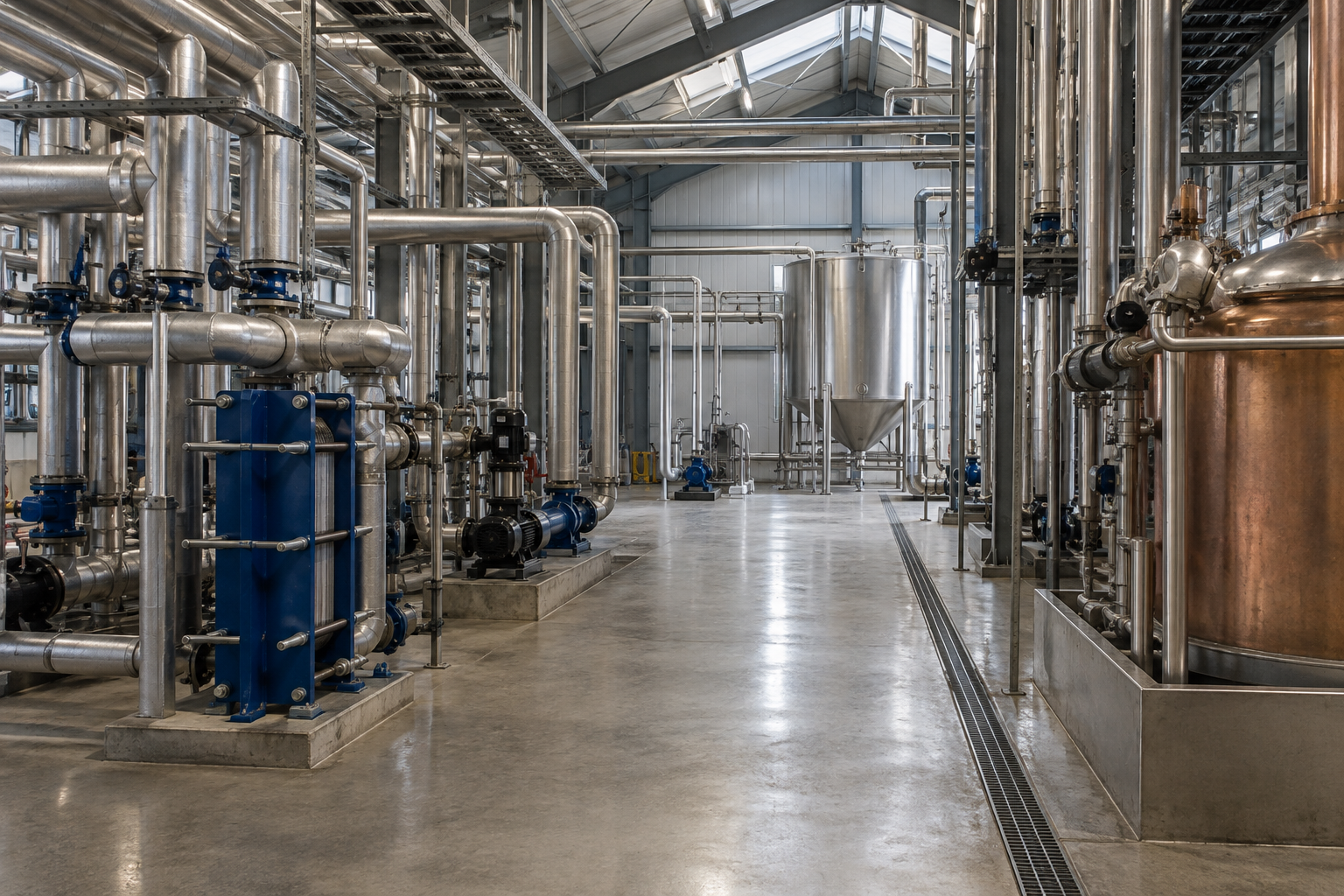
A new-build distillery needs more than sufficient electricity, water and heat. Its mechanical and electrical systems must support a production cycle, accommodate cleaning and maintenance, and serve buildings that may combine industrial operations with offices and visitor facilities. Decisions made before equipment orders are placed can determine how readily those requirements fit together.
This week's company feature examines the engineering questions behind that coordination. Glasgow-based DARe-me Consulting Engineers Ltd specialises in Building Services Design, with approved services including Mechanical Engineering, Electrical Engineering, Public Health Engineering, Net Zero Design, BMS, Energy Efficiency, Building Physics, BIM and CAD. The guidance below describes general engineering good practice, rather than a company project case study.
1. Start with an operating brief, not an equipment list
An equipment schedule is necessary, but it does not explain how a distillery will operate. The design brief should establish production hours, batch sequences, cleaning periods, staffing, visitor occupancy and expected seasonal variation. It should distinguish opening-day requirements from future expansion rather than treating every possible load as an immediate requirement.
Process suppliers should provide utility information covering peak demand, normal demand, required temperatures and pressures, start-up conditions and operating duration. A single connected-load figure rarely gives enough information to size a supply intelligently. The engineering team needs to know which demands coincide and which occur at different points in the production cycle.
A responsibility matrix should then define the boundary between process equipment and building services. For each interface, identify who designs, supplies, installs, controls and tests it. Connections to cooling equipment, package boilers, extract systems and process drainage can otherwise fall between packages, even when every individual supplier has met its own specification.
2. Test site utility capacity before fixing the layout
Electrical capacity, water availability and drainage arrangements deserve early investigation. An existing connection or a nearby main does not establish that the required capacity is available. Obtain supplier information and distinguish preliminary indications from confirmed connection offers, including any reinforcement work and delivery constraints.
The electrical assessment should consider maximum demand, motor starting, power quality and the consequences of losing supply. Critical controls and safe shutdown functions need separate consideration from equipment that can simply stop. Any standby or uninterruptible supply should follow a defined operational requirement, not a blanket assumption that the entire distillery needs backup power.
Water planning should separate potable, process, cleaning and any fire-protection requirements, with suitable backflow protection and treatment where needed. Process effluent requires its own assessment: flow, temperature, composition, storage or treatment needs, and discharge permissions should be addressed before drainage routes and external levels become fixed.
Expansion planning is relevant even on an undeveloped site. The proposed 75,000 sq ft expansion at Middle West Spirits provides a useful context for asking how a facility might grow. That does not mean installing all future capacity immediately: reserving plant space, cable routes and connection points may be the more proportionate approach.
3. Match heat supply and recovery to the production cycle
Distilling creates opportunities to examine heating and cooling together, but useful recovery depends on more than the presence of waste heat. The source must offer an appropriate temperature, quantity and timing, and there must be a demand capable of accepting it. Batch operation makes this matching exercise particularly important.
Prepare a heat-demand profile before selecting technology. Separate high-temperature process requirements from lower-temperature duties such as space heating or water preheating. Where supply and demand do not coincide, assess whether thermal storage is practical, considering space, standing losses, controls and operating temperatures. Keep process quality and hygiene requirements central to any proposal.
The solar-powered distillery proposal from Blue Run Spirits illustrates why energy strategy belongs in the early project brief. For any new-build scheme, however, renewable electricity generation and process-heat provision need distinct assessments. Annual generation figures alone do not demonstrate that production demand will be met when required.
Compare options against the same operating assumptions, including fuel and electricity availability, maintenance, tariffs and anticipated production changes. A system that performs well at full output may be less suitable during a gradual production ramp-up. Metering should be planned alongside the plant so that operating performance can later be checked against the design assumptions.
4. Define hazardous-area responsibilities explicitly
Where flammable vapours may be present, hazardous-area requirements must inform the layout and services design early. For a project in Great Britain, DSEAR responsibilities and the competent assessment of explosion risks need to be established. Hazardous-area classification should inform equipment selection and installation; it should not be inferred casually from a room's name or general purpose.
Hazardous-area building services design is not the same as undertaking a formal DSEAR risk assessment, issuing certification or fulfilling every specialist duty. Appointments should state who provides the assessment and classification, who specifies equipment against applicable ATEX-related requirements, and who undertakes inspection and verification. These responsibilities should remain visible across procurement packages.
Ventilation design must follow the relevant risk assessment and operating conditions. If ventilation is relied upon as a protective measure, the team should determine how its availability is monitored and what happens on failure. Alarm responses, interlocks and shutdown arrangements need a documented cause-and-effect strategy rather than assumptions left for commissioning.
Fire strategy, escape routes and maintenance access also affect services coordination. Cable routes, ductwork and pipework must be considered alongside compartmentation and penetrations. Visitor access introduces another interface: public circulation should not compromise operational segregation or safe access to industrial plant.
5. Coordinate space, access and controls before installation
Plant space is not simply the footprint of equipment. Layouts need room for filter changes, valve operation, electrical working clearances, lifting and eventual replacement. Check the route by which large components will enter and leave the building, including doors, roof openings and any dependence on temporary lifting equipment.
BIM and CAD can support coordination, but a clash-free model is not proof that a system can be maintained. Review the model with process suppliers, operators and those responsible for maintenance. Include supports, insulation, falls on drainage, access zones and penetrations rather than relying on simplified equipment blocks.
Controls require equally clear boundaries. A building management system can monitor building services, while process controls manage production duties; the exchange of signals between them must be defined. Agree which system owns each command, alarm and operating schedule, and avoid giving two systems conflicting authority over the same plant.
6. Design commissioning and handover into the programme
Commissioning should begin as a design requirement, not appear as a final programme activity. Provide suitable isolation, test points, measuring devices and access. Agree what constitutes an acceptable result, who witnesses testing and which dependencies must be satisfied before process trials begin.
Test systems together as well as individually. Relevant scenarios may include peak utility demand, ventilation failure, loss and restoration of power, and restart after a shutdown. Coordinate these tests with the process and safety teams under agreed procedures. Some checks will require production conditions or a later seasonal visit, which should be allowed for explicitly.
Handover should include accurate drawings, asset information, control descriptions, operating instructions and training. For distillery owners, the value of early M&E coordination is a clearer connection between production ambition and the infrastructure needed to support it. For project teams, it exposes decisions while layouts, procurement packages and utility strategies can still be changed without disrupting installed work.
To discuss a new-build distillery project or feasibility study, contact DARe-me Consulting Engineers Ltd through its website or at enquiries@dare-me.co.uk.